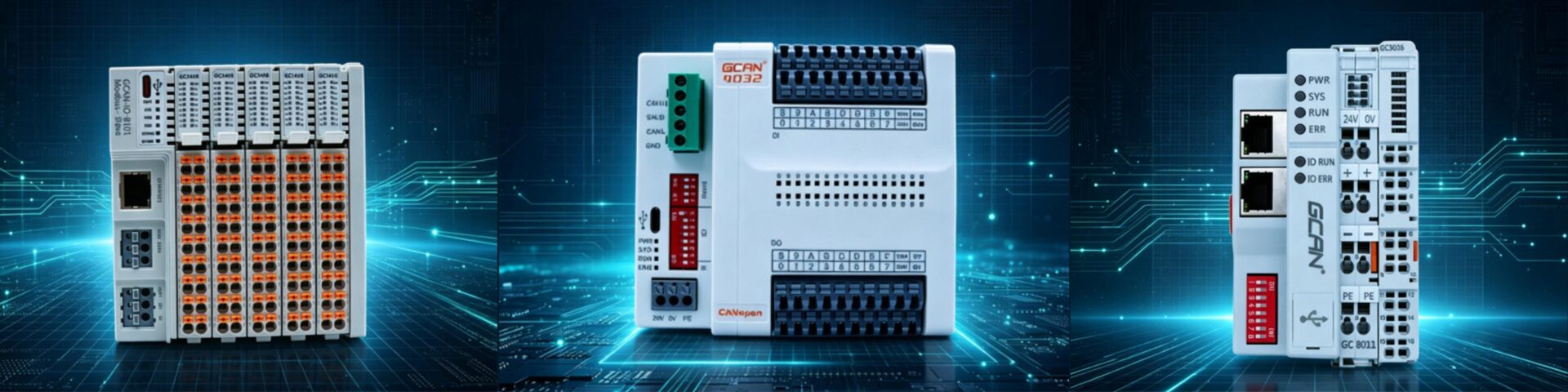
🔵 Overview
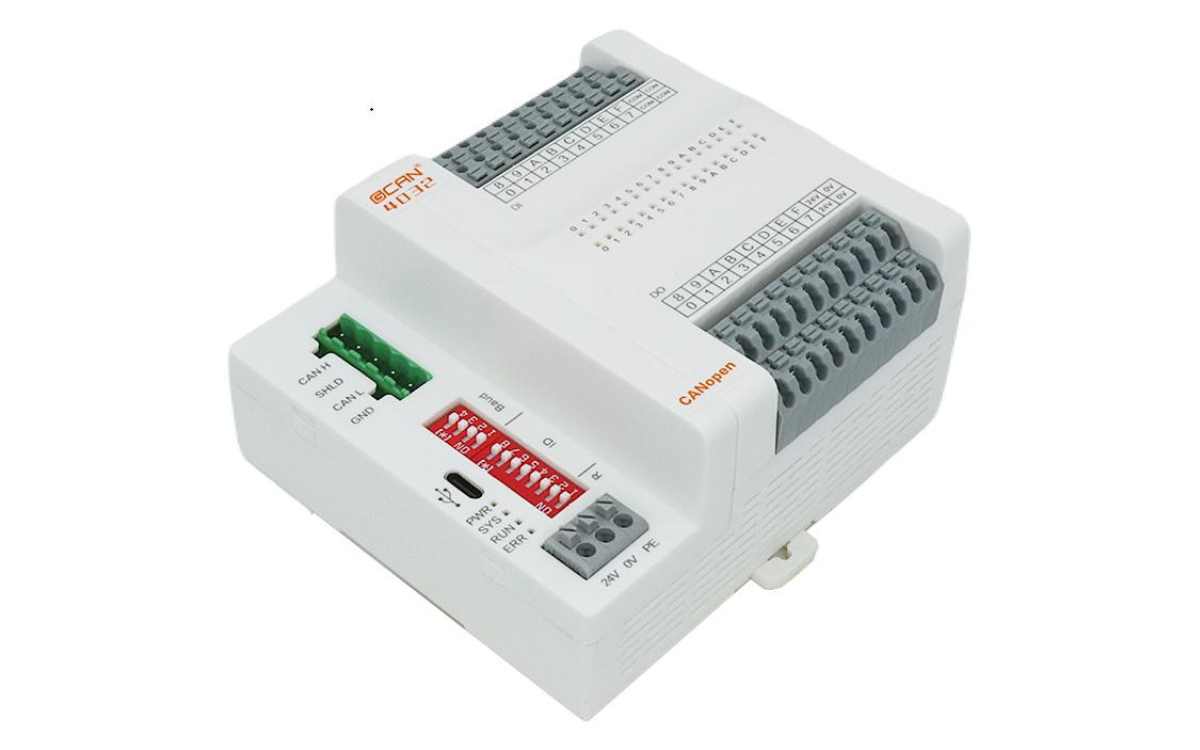
- The GCAN-I/O-5032 is an industrial-grade EtherCAT Remote I/O Module designed to expand digital I/O capabilities over a high-speed EtherCAT network.
- Compliant with the standard EtherCAT protocol, it acts as a reliable slave node, providing 16 Digital Inputs (DI) and 16 Digital Outputs (DO).
- Equipped with dual RJ45 ports, spring-cage terminals, and 1500V DC isolation, it ensures fast wiring and safe operation in harsh industrial environments.
🔵 Critical Selection Guide: Wiring & Output Types
Before installing, please note the hardware configuration features for your specific application:
- DI (Source/Sink Input): 16 channels. The input type can be switched between Source (Source-type) and Sink (Sink-type) simply by changing the wiring connections.
- DO (PNP/NPN Output): 16 channels. Defaults to PNP transistor output. NPN output is available upon request. Max output current is 500mA per channel (single), and 300mA (PNP) / 280mA (NPN) for simultaneous multi-channel output.
- Terminals: Spring-cage push-in terminals allow for fast, screwdriver-free wiring, significantly reducing installation time.
🔵 Do You Need Distributed I/O Expansion?
💡 1 - Distributed I/O Expansion for EtherCAT Networks
(Model: GCAN-I/O-5032 acts as an EtherCAT Slave)
❓ The Challenge: Modern PLCs or EtherCAT masters often have limited built-in I/O points. When machines or sensors are distributed across a large factory floor, running individual cables for every sensor back to the central PLC is expensive, complex, and prone to interference.
🛠️ The Solution: The GCAN-I/O-5032 module is installed locally near the sensors/actuators. It gathers the 16 DI signals and controls the 16 DO outputs locally. The data is seamlessly transmitted to the central EtherCAT Master via standard Ethernet CAT5 cables at 100Mbps using highly efficient process data mapping. It supports auto-configuration, eliminating the need for complex parameter settings on a PC.
💎 The Value: Dramatically reduces wiring costs and complexity. The dual RJ45 interfaces allow for easy daisy-chaining. The 1500V DC isolation and EMC protection ensure your central controller is shielded from electrical noise. With spring-cage terminals, field engineers can wire the module in minutes, saving valuable commissioning time and hardware expenses.
💡 2 - High-Speed Synchronization for Motion & Process Control
(Model: GCAN-I/O-5032 acts as an EtherCAT Slave)
❓ The Challenge: Traditional fieldbus networks often struggle with latency and jitter when handling large amounts of I/O data alongside precise motion control tasks. This lack of synchronization can lead to production errors, slower cycle times, and inefficiencies on automated assembly lines.
🛠️ The Solution: Leveraging EtherCAT's high-speed 100Mbps transmission and efficient process data mapping, the GCAN-I/O-5032 ensures microsecond-level synchronization with the EtherCAT master. It accurately captures time-critical sensor signals (DI) and triggers actuators (DO) at the exact moment required, integrating seamlessly into high-speed automation architectures.
💎 The Value: Achieve unmatched system responsiveness and deterministic control. By minimizing communication delays, the module maximizes machine throughput, reduces synchronization errors in multi-axis systems, and guarantees precise timing for your most demanding production tasks.
💡 3 - Flexible Topology & Space-Saving Cabinet Design
(Model: GCAN-I/O-5032 acts as an EtherCAT Slave)
❓ The Challenge: Modern factory floors and robotic cells often face limited control cabinet space and complex wiring layouts. Installing point-to-point I/O wiring from a central PLC to distantly located devices increases cable costs, creates cable clutter, and complicates troubleshooting and future system expansions.
🛠️ The Solution: Featuring dual RJ45 interfaces, the GCAN-I/O-5032 supports daisy-chain (line) topology, allowing multiple modules to be easily connected in series without the need for costly external switches. Its compact DIN-rail mountable design and spring-cage terminals enable quick, tool-free installation directly inside the machine or a narrow control cabinet.
💎 The Value: Drastically reduce wiring materials and cabinet footprint. The flexible daisy-chain topology shortens cable runs, lowers installation costs, and makes system scaling (adding more I/O points later) incredibly easy and cost-effective for future factory upgrades.
GCAN-I/O-5032 EtherCAT Remote I/O Module with 16 Digital Inputs and 16 Digital Outputs.
16-Channel EtherCAT Remote I/O Module
16-Channel Digital Inputs (DI) and 16-Channel Digital Outputs (DO)
Standard EtherCAT Slave (ESI file available) for seamless PLC integration
Spring-cage push-in terminals for fast, screwdriver-free wiring
1500V DC electrical isolation for harsh industrial environments
Operating Temp. from -40°C to +85°C
Dual RJ45 EtherCAT ports, DIN-rail mounting, and USB-C port for firmware upgrades
Find Your EtherCAT Remote I/O Solution by Application
◆ Application 1: My PLC has run out of built-in I/O points, and I need to add more sensors and actuators.
👉 Product model: GCAN-I/O-5032
💡 How it works:
➤ Role: Acts as an EtherCAT I/O expansion module (Slave).
➤ Connection: Connects to the EtherCAT Master (e.g., Beckhoff, Omron, or standard PLCs) via standard RJ45 cables. Field devices (proximity sensors, push buttons) are wired to the 16 DI spring terminals, while actuators (solenoid valves, relays) are wired to the 16 DO terminals.
➤ Process Data Exchange: The PLC imports the ESI file (XML) and uses standard PDO mappings to read the DI states and write DO commands. The module supports auto-configuration (no PC setup required), accurately translating these digital commands into physical 24V outputs.
◆ Application 2: The sensors are far away from the main control cabinet, and direct wiring is too expensive.
👉 Product model: GCAN-I/O-5032
💡 How it works:
➤ Role: Acts as a Distributed Remote I/O node.
➤ Connection: Installed locally near the field equipment (e.g., at the end of a conveyor line). With its dual RJ45 ports, it supports daisy-chain (line) topology. Only a single standard Ethernet CAT5 cable (100Mbps, max 100m per station) is needed to connect back to the main controller.
➤ Network & Cost Efficiency: Drastically reduces cable lengths, minimizes electrical interference, and saves significant wiring material costs while ensuring high-fidelity signal acquisition.
◆ Application 3: I need high-speed, real-time synchronization for fast machine cycles or motion control.
👉 Product model: GCAN-I/O-5032
💡 How it works:
➤ Role: Acts as a high-speed EtherCAT Slave node in a deterministic network.
➤ Connection: Integrated into a high-speed control loop where microsecond-level response is required (e.g., packaging machinery, robotic cells).
➤ Real-Time Synchronization: Leveraging the 100Mbps EtherCAT protocol, the module guarantees precise timing between signal acquisition (DI) and actuation (DO). The 1500V DC electrical isolation and -40°C to +85°C wide temperature range ensure flawless performance even in harsh, high-vibration industrial environments.
Technical Specifications
Choose the Right Remote I/O for Your Application
| Model | Bus Protocol | Module Type | I/O Configuration | Signal Type | Terminal Type | Key Application / Feature |
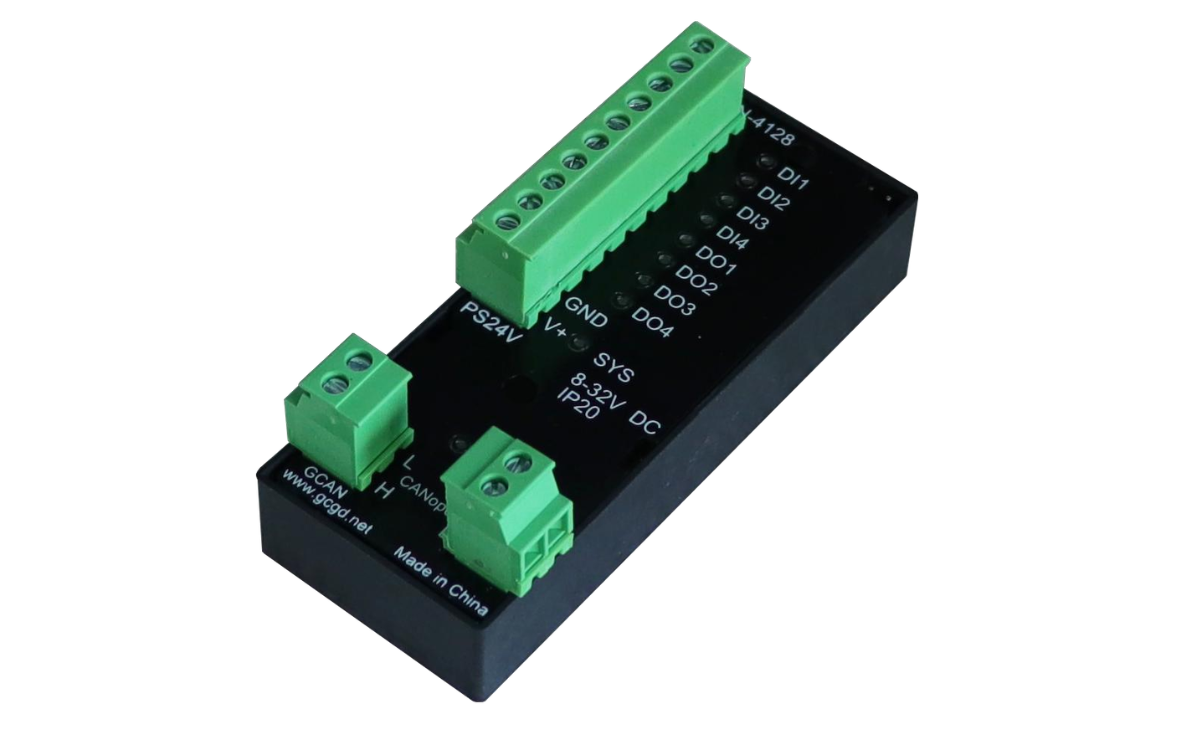
| GCAN-4128 | CANopen / CAN | Compact (Micro) | 4 DI / 4 DO | Digital | Screw Terminals | Ultra-compact digital I/O for tight spaces; supports standard CAN & CANopen. |
| GCAN-4032 | CANopen | Compact | 16 DI / 16 DO | Digital | Spring-Cage | High-density digital I/O; ideal for standard 24V switch/actuator control. |
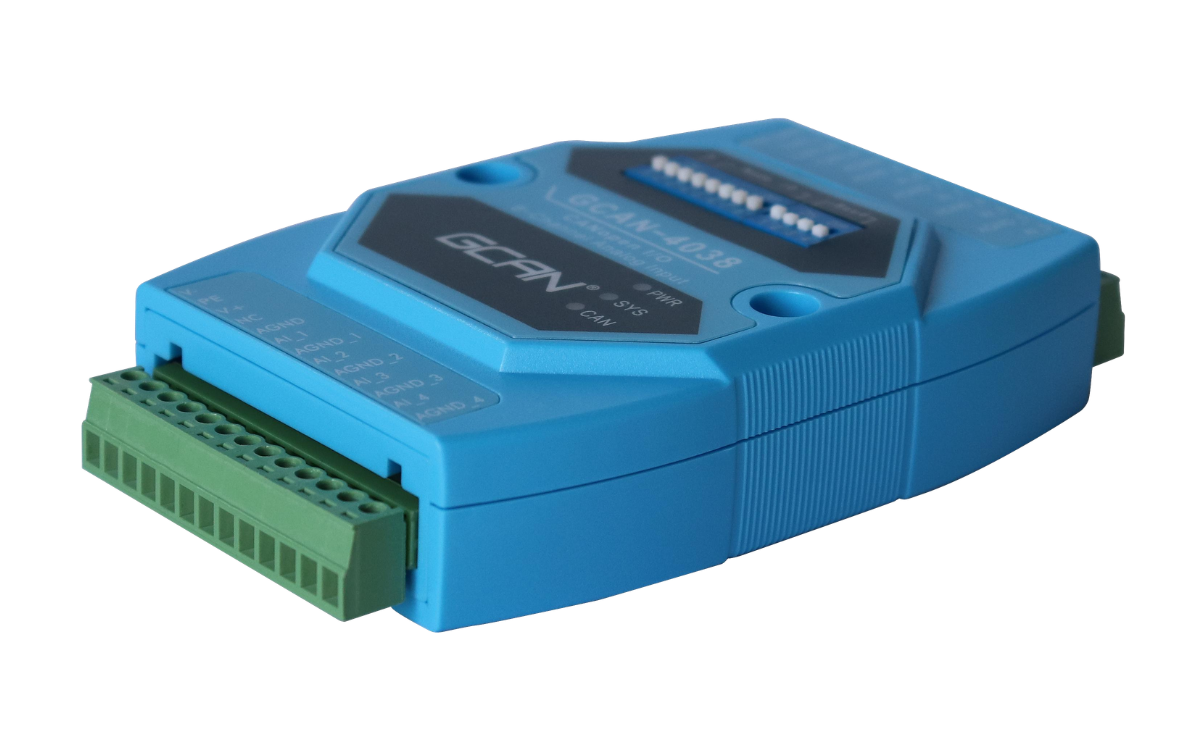
| GCAN-4038 | CANopen | Compact | 8 AI (Differential) | Analog | Screw Terminals | High-precision analog data acquisition (-10~+10V, -20~+20mA, etc.). |
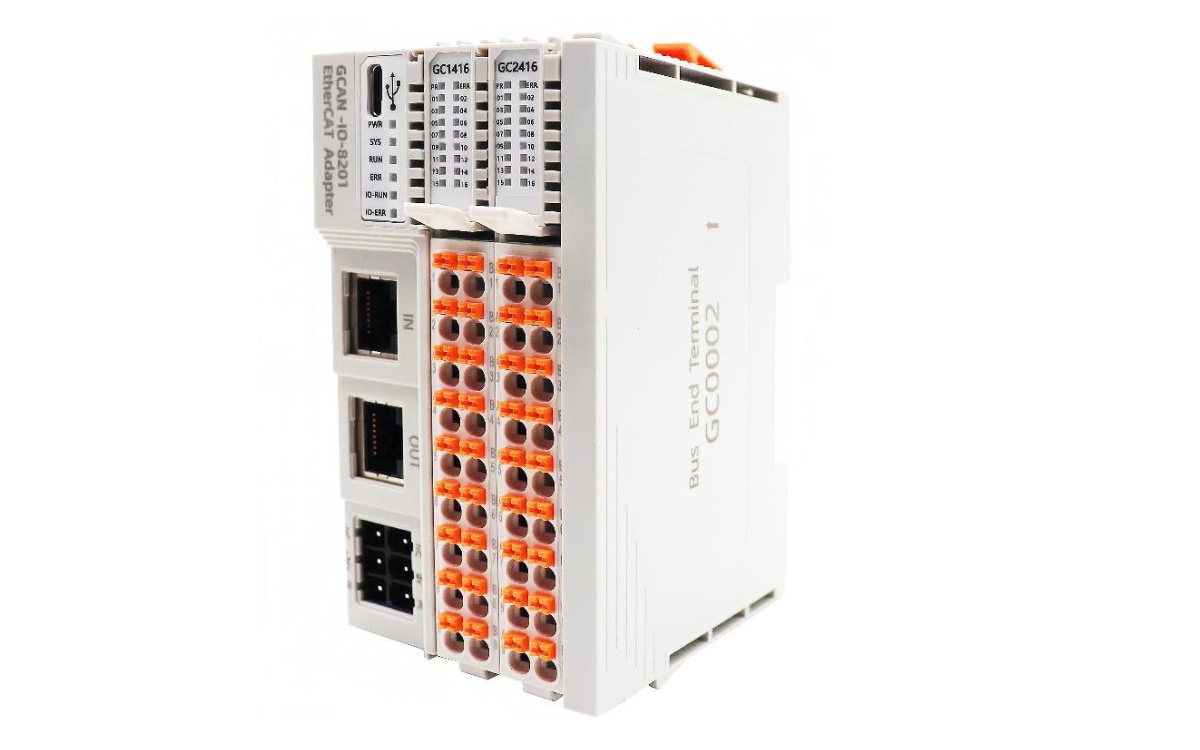
| GCAN-5032 | EtherCAT | Compact | 16 DI / 16 DO | Digital | Spring-Cage | High-speed real-time digital I/O for motion control and EtherCAT networks. |
| GCAN-IO-8101 | Modbus TCP/RTU | Modular Coupler | Expandable (0 local I/O) | Mixed (via slices) | Spring-Cage (GC-Bus) | Head coupler for Modbus networks; supports up to 32 GC series I/O slices. |
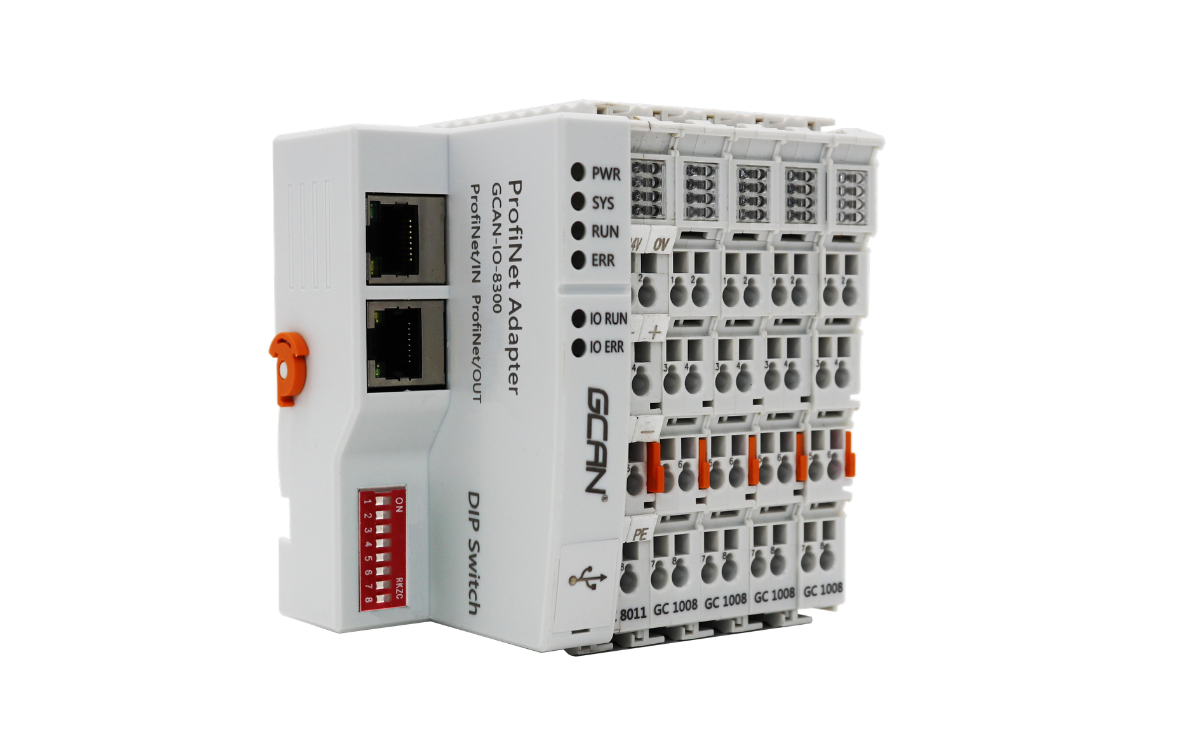
| GCAN-IO-8300 | Profinet | Modular Coupler | Expandable (0 local I/O) | Mixed (via slices) | Spring-Cage (GC-Bus) | Pure Profinet coupler for Siemens PLCs; max 340 bytes IN/OUT, up to 32 slices. |
GCAN-I/O-5032 EtherCAT I/O Module: Installation, Wiring, and Setup FAQs
Q How to connect the GCAN-I/O-5032 to an EtherCAT Master (PLC)? ▼
- Simply import the provided ESI (XML) file into your EtherCAT Master (e.g., TwinCAT, Omron). --The module acts as a standard EtherCAT Slave and supports auto-configuration. No complex parameter settings or programming are required on the module itself.
Q How to wire the 16-channel DI for Source (PNP) or Sink (NPN) sensors? ▼
- The input type is selectable via wiring; no software or DIP switches are needed.
- You can easily switch between Source-type and Sink-type simply by changing the wiring connections on the spring-cage terminals. (Input ON voltage: ≥ 9V DC / OFF: ≤ 5V DC).
Q What is the maximum output current for the 16-channel Digital Outputs (DO)? ▼
- The DO defaults to PNP transistor output (NPN available upon request). The max current is 500mA per single channel.
- When multiple channels are outputting simultaneously, the total current limit is 300mA (PNP) or 280mA (NPN) at 24V DC. Do not exceed this limit to prevent overheating.
Q How do I map the process data of GCAN-IO-5032 to the EtherCAT master? Is additional PC configuration software required? ▼
- No PC configuration software is required. The GCAN-IO-5032 features hardware auto-configuration and automatic process data mapping.
- You only need to import the provided ESI (EtherCAT Slave Information) file into your EtherCAT master project (e.g., TwinCAT, CODESYS). Once the slave is scanned, the 16DI/16DO states are automatically mapped to the master's process image, and the module can run independently offline after power-on.
Q Can I daisy-chain multiple modules using the dual RJ45 ports? ▼
Yes. The dual RJ45 EtherCAT ports (IN & OUT) support daisy-chain topology, allowing you to connect multiple GCAN-I/O-5032 modules in series without an external switch. The max distance between stations is 100m using standard Ethernet CAT5 cables.
Q How is the module mounted, and how do I update the firmware? ▼
- It supports standard DIN-rail mounting with a compact design (115x100x58mm).
- There is a dedicated USB Type-C port on the front for easy on-site firmware upgrades without opening the housing.
Q Can the USB Type-C port on the module be used for EtherCAT communication or parameter settings? ▼
- No. The USB Type-C interface is dedicated to on-site firmware updates. It does not support standard PC configuration or business communication. Field engineers can upgrade the firmware directly without opening the housing.
- Communication parameters and configuration are managed entirely by the master station via the ESI file, so no additional debugging is needed through this port.
Q What should I note regarding the power wiring of GCAN-IO-5032? Can the system power and IO power share the same supply? ▼
- Separate power supplies are recommended.
- The module has an independent system power interface and 2 groups of IO power interfaces (internally shorted; connect 24V to either one). The IO power and system power are electrically isolated (1500V DC isolation). The DI side supports source/sink wiring switching, and the DO side defaults to PNP transistor output (NPN optional). The maximum current is 500mA per channel, and derating applies when multiple channels output simultaneously.